
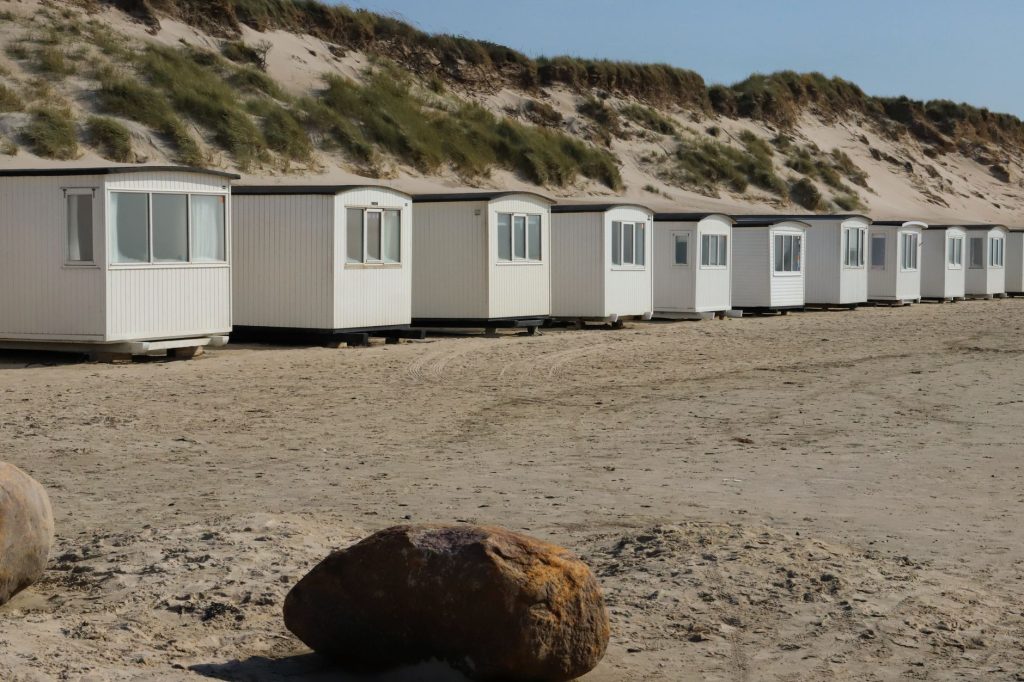
First and foremost, your holiday home is your own holiday retreat. You are free to let it out for shorter periods, as long as you also use it for holidays yourself. But once the letting changes character and becomes commercial, different rules apply.
The Danish Planning Act (planloven) governs how the houses are used, while the Danish Holiday Home Act (sommerhusloven) governs the letting itself. Holiday homes in holiday home areas may only be used for recreational purposes. Living in one all year round generally requires an exemption from the municipality. However, pensioners who have owned their holiday home for at least one year have a personal right to live there all year round (Source: the Planning Act, §§ 40 and 41). Holiday stays count as recreational, which is why letting to holidaymakers is generally legal.
The first limit concerns how much you may let it out. A holiday home may legally be let for up to 41 weeks a year. According to Feriehusudlejernes Brancheforening, the trade association for holiday home letting agencies, the average holiday home is let for just under 18 weeks a year (Source: BDO 2026). That is well below the 41 weeks.
The second limit concerns when the letting changes character. If the holiday home is used solely for letting all year round, it counts as commercial letting. That requires a permit under the Holiday Home Act from Plan- og Landdistriktsstyrelsen (the Danish Agency for Planning and Rural Development), and as a rule, such a permit is not granted (Source: Plan- og Landdistriktsstyrelsen).
As a private individual, you may generally let out up to two holiday homes, provided you use each of them yourself for at least 2 weeks a year. Since a change in practice in 2017, spouses and cohabiting partners each have their own limit, so a couple can let out up to four holiday homes (Source: Erhvervsstyrelsen’s guidance on letting holiday homes, 2021).
So the rules on the letting itself come down to two questions: how much you let the house out, and how much you use it yourself. The rest of the article goes through the tax, the deductions and the practical obligations once you are up and running.
Tax on rental income from a holiday home
When you let out your holiday home, you need to keep track not only of how much you are allowed to let it out, but also of the tax on the rental income.
The first thing you need to know is what counts as rental income. It is not enough to look at the rent guests pay for the stay itself. Payments for electricity, water and heating count towards the rental income, and you must calculate the tax on the full amount, including utilities (Source: skat.dk).
However, you do not have to pay tax on every single krone you take in. Thanks to the tax-free allowance (bundfradrag), part of the rental income is tax-free. How large the allowance is depends on how you let the house out. You can read more about that in the next section.
For the part of the rental income above the allowance, a fixed split applies. You pay tax on 60 % of the amount above the allowance, while the remaining 40 % is a standard deduction intended to cover all your letting expenses (Source: BDO 2026).
The taxable amount, i.e. the 60 %, is taxed as capital income. In 2026 the marginal tax rate on it is between roughly 25 and 42 % (Source: Skatte- og Vækstministeriet). Capital income is taxed at different rates from ordinary earned income, and the exact tax depends on your overall financial situation.
One detail that is easy to overlook concerns ownership. If you own the holiday home together with others, for example a spouse or a friend, Skattestyrelsen (the Danish Tax Agency) divides both the rental income and the allowance between the owners according to the share each of you owns (Source: Dansk Revision). So you do not necessarily have to declare the full income on your own annual tax statement (årsopgørelse), only the part that corresponds to your share of ownership.
You should also remember that it is your responsibility to make sure the rental income is correctly included on your annual tax statement. This applies whether you let through a platform or arrange it directly with the guests. A reporting platform sends your income details to Skattestyrelsen, but if you let privately, you must declare the taxable amount yourself.
If you have only owned the holiday home for part of the year, you must also declare the taxable amount yourself. This applies even if you let through a reporting platform (Source: skat.dk). You can read where the amount goes on your annual tax statement in the last section of the article.

Tax-free allowance when letting through an agency or on your own
The size of the tax-free allowance depends on how you let the house out. There are two different allowances: one applies when you handle the letting yourself, and the other when you let through a reporting platform.
| Letting it yourself without an agency | Letting through a reporting agency | |
|---|---|---|
| Tax-free allowance 2026 | 13.800 kr. | 50.200 kr. |
| Tax-free allowance 2025 | 13.100 kr. | 47.900 kr. |
Both amounts are tax-free and come from skat.dk (2026). The higher allowance for letting through an agency applies when the agency reports to Skattestyrelsen or to a foreign tax authority.
The reason the difference is so large lies in the reporting obligation. On 1 January 2023 the DAC7 directive came into force, obliging digital platforms to report information about their users’ rental income to Skattestyrelsen or a foreign tax authority (Source: skat.dk). Because the authorities receive the figures directly this way, the higher allowance is intended as a benefit for you if you let through that route.
An important detail is that for 2023, 2024 and 2025, you are entitled to the higher allowance if you have let through a platform that is obliged to report, regardless of whether the platform actually reported or not (Source: skat.dk).
It can be tempting to think you can simply choose the higher allowance, however you let the house out. But you cannot get the allowance for agency letting and for private letting at the same time (Source: skat.dk).
There is, however, an overlap you should know about. If your income through the platform is below 13.800 kr. in 2026 (13.100 kr. in 2025), you can use the rest of the allowance on private letting (Source: skat.dk).
Finally, there is a question of timing that often causes confusion. The allowance applies for the whole year, even if you buy or sell the holiday home during the year (Source: skat.dk). The allowance is adjusted every year, so the amounts for 2026 are not the same as for 2025, and they may change again next year.

The accounting method as an alternative to the tax-free allowance
There is another way of calculating your letting income than using the tax-free allowance. It is called the accounting method (regnskabsmetoden). With this method you do not get a tax-free allowance, but in return you may deduct your actual expenses in your accounts (Source: BDO 2026).
With the tax-free allowance, you get an amount tax-free, but you cannot deduct expenses such as electricity, water, heating or land tax (grundskyld), nor can you get a reduction in your property value tax (ejendomsværdiskat). If you choose the accounts-based deduction instead, you are taxed on the full rental income, but you can deduct the expenses you have actually incurred (Source: BDO 2026).
One of the expenses you can deduct is the proportionate share of land tax for the weeks the house is let. The same principle applies to the reduction in property value tax, which is tied to the weeks you let the house out.
Besides land tax, your accounts can include a number of other items:
-
Depreciation on furniture and fittings (though not white goods), plus maintenance of those items (Source: BDO 2026)
-
Running costs for electricity, gas, water and heating (Source: Redmark/Dansk Revision)
-
Advertising costs related to the letting (Source: Redmark/Dansk Revision)
Note that you cannot deduct the cost of maintaining the house itself (Source: skat.dk).
There is, however, a catch you need to know about before you decide. You can switch from the allowance method to the accounting method, but not back the other way (Source: skat.dk/BDO). In other words, choosing the accounting method is permanent.
So it is a good idea to talk to an accountant before you switch to the accounting method.
Finally, be aware that both methods only apply when you use the holiday home for your own holidays and the letting is not commercial. If the house is used only for letting, it counts as commercial letting, and the profit is then taxed as personal income under different rules (Source: skat.dk).
Whichever method you use, letting a holiday home is generally exempt from VAT (moms). You do not charge VAT on the rent, and you cannot deduct VAT on your expenses (Source: skat.dk).
Property value tax when you let out your holiday home
Property value tax is easily overlooked when you start letting. If you choose the accounting method, you do not pay property value tax for the time the holiday home is let (Source: skat.dk). This does not happen automatically: you have to report the period yourself.
You have to state on your annual tax statement how long you let the house out (Source: skat.dk). It is your responsibility to include the letting period, whether you let through a platform or arrange it directly with the guests. If you do not report it, you will be left with property value tax calculated for the whole year, and you will end up paying for a period you should not have paid for.
If you choose the allowance method, you cannot get a reduction in your property value tax (Source: skat.dk / Samlino). The reason is that the 40 % deduction is also meant to cover property value tax for the weeks the house is let. You therefore pay property value tax for the whole year (Source: Den juridiske vejledning C.H.3.4.2.1).
If you choose the accounts-based deduction instead, the picture looks different. You get a deduction for property tax, and you do not pay property value tax during the letting period (Source: Dansk Revision). However, this only applies to the weeks you actually let the house out, not to the whole year.
Land tax follows the same logic of proportional division. You can deduct the share of land tax that corresponds to the weeks you let the house out (Source: skat.dk). If, for example, you let it for four weeks, you can deduct 4/52 of the land tax. The year has 52 weeks, and you only count the portion that belongs to the letting period.
If you choose the accounting method, you should keep track of how many weeks you let the house out as you go. That way you will have the figure ready when you need to report the letting period on your annual tax statement and work out how much of the land tax you can deduct.
Insurance, safety and homeowners’ association rules
Tax is only half of it. The other half is the practical things that need to be in place before the first guest gets the key. Here, the requirements come not from Skattestyrelsen but from your insurance company, the municipality and the homeowners’ association (grundejerforening) you belong to.
Who takes care of what depends on how you let the house out. Whichever route you choose, there are four things you should have in order:
-
If you let through an agency, the agency often handles contracts, insurance and collecting payment for you. If you let privately, it is all your own responsibility, and you have to keep on top of the agreements, the cover and the payments yourself (Source: Wonderstay.dk).
-
The municipality may have its own rules on letting holiday homes. These could, for example, be provisions in the local plan for the area on how the houses may be used (Source: the Planning Act, § 38 a). Check them with the municipality before you put up an advert.
-
The rules (vedtægter) of your homeowners’ association can restrict letting or ban it altogether, even if the law allows it. So read the rules through before you start.
-
Check the house for fire and safety issues before you let it out for the first time. Among other things, that means working smoke alarms and clear escape routes, and it is a good idea to document the check so you can show it if your insurance company asks.
A check of the house can seem like a formality. But if something happens during a stay, you are in a stronger position if you can document the condition the house was in. Whether the damage is covered depends on the terms of your insurance.
How to find the current rates each year
The tax-free allowance is adjusted every year, and an amount you remember from last year’s statement will not necessarily apply to the income year you are dealing with now. You need to find the rates that apply to your income year, and you do that by looking them up on skat.dk and checking your annual tax statement (Source: skat.dk).
-
On skat.dk you will find the pages “Du udlejer dit sommerhus” (renting out your holiday home) and “Du udlejer et værelse eller en bolig, du selv bor i” (renting out a room or a home you live in yourself). Skattestyrelsen updates the amounts and rules there when they change (Source: skat.dk).
-
If your rental income is not reported automatically by an agency, declare it on your annual tax statement in box 37. On the preliminary income assessment (forskudsopgørelse), the equivalent is field 218. If an agency does report your income, always check that the figures on your annual tax statement match what the agency has reported (Source: skat.dk).
This article is general information, not advice. If you need specific advice about your own situation, contact an accountant or read Skattestyrelsen’s guidance on skat.dk.
Leave a comment