
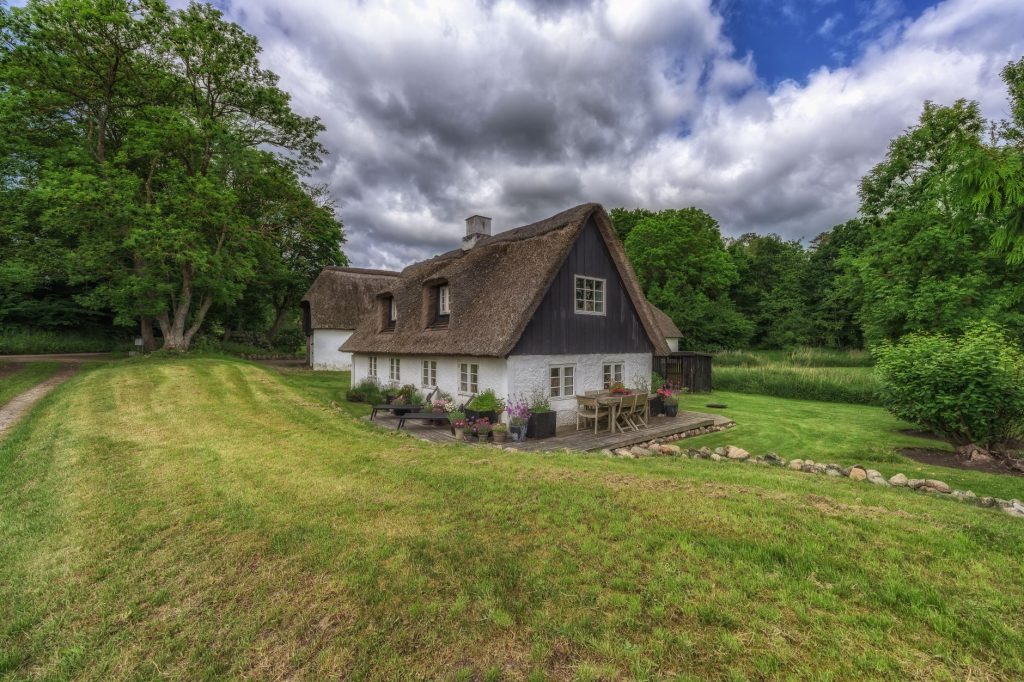
Holiday home prices in 2026 are at the highest level ever recorded. The rise is also broad-based, lifting the holiday home market in almost every part of the country, not just on the most sought-after coasts.
The figures for the 2nd quarter of 2026 set the direction. The average price of a holiday home sold is 25.164 kr. per m², a rise of 10,7 per cent over the past year and the highest price ever, not adjusted for inflation. An average 91 m² holiday home costs 2,3 million kr.
Prices have risen in 38 municipalities and fallen in 5 over the past year, and prices are unchanged in every region and part of the country except North Jutland. Looking further back, the picture is even clearer: since February 2020, prices have risen in every holiday home municipality. Odsherred/Rørvig is up 77 per cent, Guldborgsund 71 per cent and Lolland 65 per cent.
In practice, four things decide what a holiday home costs: location, season, letting and condition. You can look at them one at a time, so it becomes clear how each factor moves the price up or down.
Location: from Helsingør to Lolland
Location is the single factor that moves the price of a holiday home the most. Being close to the beach, the woods and scenic surroundings can lift the price considerably, and a house in a popular holiday area is typically priced higher than a similar house a little further from the coast and the tourists.
Here are the price levels in the three most expensive and the three cheapest holiday home municipalities in the 2nd quarter of 2026, measured as the average price per m² for houses sold:
| Municipality | Price per m² |
|---|---|
| Helsingør | 55.542 kr. |
| Aarhus | 48.204 kr. |
| Gribskov | 38.562 kr. |
| Skive | 11.574 kr. |
| Vesthimmerlands | 12.840 kr. |
| Aalborg | 12.851 kr. |
The gap between top and bottom is almost a factor of five. A house of the same size can cost several million more simply because it is in Helsingør rather than in Skive.
The differences also exist within each municipality. Some holiday home areas have become more popular and overtaken others in the same municipality, so two houses the same distance from the water can be far apart in price if one area has come into fashion. Parts of the country such as Funen are up 22,5 per cent and Bornholm 19,9 per cent over the past year.
You cannot judge whether a house is worth the price from its size and condition alone. You need to look at where in the municipality it is and what has happened to prices in that particular area.
How the season affects the price
The time of year moves both activity and prices. Holiday home sales really pick up in April and peak from mid-May to the end of June, when the most houses change hands. Over the last 10 years, an average of more than 250 holiday homes a week have been sold in the high season, compared with about 190 in an ordinary week and about 130 in December and January. So there is markedly more to choose from as spring turns into early summer.
Prices follow activity. Over the past 15 years, holiday home prices have on average been about 2,1 per cent higher in June than in an average month and about 1,9 per cent lower in February. In kroner, a holiday home costing 2 million kr. costs about 2.041.000 kr. in June against about 1.961.000 kr. at the beginning of February, if prices are otherwise unchanged. That is the premium you pay for buying in the middle of the high season.
Early summer is not necessarily a bad time to buy, though. Demand and rental income are highest in the summer months, and if the house is handed over to you before the summer holidays, you secure the year’s most lucrative letting weeks from day one. The potential rental income in the summer weeks can offset some of the premium you pay for buying in the high season.
Holding costs such as property taxes, insurance, mortgage payments and heating to prevent frost damage can be considerable, and they can make some sellers more willing to accept a lower price as autumn approaches. On the other hand, waiting for winter’s bargain months can prove expensive in a market where the most attractive holiday homes are snapped up quickly.
The advice from Lise Nytoft Bergmann, chief analyst and housing economist at Nordea Kredit: buy when your finances are in place and the right holiday home comes along. The season moves the price, but it does not decide on its own whether a house is worth the price.
Letting potential and tax
The rent you can earn from the holiday home helps determine how much you can reasonably pay for it. A house with solid rental income can support a higher purchase price, because the rent covers part of the running costs, while a house with no letting potential has to rest on your own finances alone. Tax decides how much of the rent you actually keep, so get to know the rules before you work out what a house is worth to you.
In 2026, the tax-free allowance (bundfradrag) for letting a holiday home is 50.200 kr. when you let through an agency or a digital platform that reports to the Danish Tax Agency (Skattestyrelsen). If you let privately, the allowance is 13.800 kr. Only 60 per cent of the rental income above the allowance is taxed, because the remaining 40 per cent is a standard deduction covering expenses such as electricity, cleaning and property value tax during the letting period.
You can calculate your letting income in two ways:
| The allowance method | The accounting method | |
|---|---|---|
| Deduction for electricity, cleaning and maintenance | No, the 40 per cent reduction is the expense deduction itself | Yes, actual expenses are deducted |
| What is taxed | 60 per cent of the rental income above the allowance | The actual profit |
| Property value tax | Paid in full | Can be reduced proportionally for the weeks the house is actually let |
Whichever method you use, a holiday home may, as a rule, be let for up to 41 weeks a year and must also be used for leisure. It is not a house you can let all year round as a pure business.
The calculation is easiest to follow with a concrete example of letting through an agency:
-
You start with 100.000 kr. in rental income.
-
Deduct the allowance of 50.200 kr., and you have 49.800 kr. left.
-
60 per cent of 49.800 kr. is taxed, which comes to 29.880 kr.
-
At a tax rate of 37 per cent, you pay about 11.100 kr.
-
You keep about 88.900 kr.
Most of the rent stays with you when you let through a platform that reports to the Danish Tax Agency. That income is what can make a more expensive house add up financially.
Condition, energy and maintenance
Condition is the factor that is easiest to overlook in a listing. Yet exterior maintenance, insulation and the state of the roof play a big part in what the house costs you in the long run. If the roof needs replacing or the insulation dates from an earlier era, there are costs waiting for you once the house is handed over. Conversely, new builds or renovated houses with modern kitchens and bathrooms can lift the price. That applies both to the finish and to the number of years before the big jobs need doing.
Electricity, water and heating are where the difference between two otherwise comparable houses becomes clear. In older houses with poor insulation, running costs can vary a lot, and you pay them every month. Houses with low energy consumption and efficient heating solutions are often more sought after and more expensive to buy, because demand is greater. You pay for the energy improvements when you buy, but you recoup some of the amount through lower running costs.
The hidden costs are part of the calculation. Property tax, insurance and maintenance should be factored in from the start, and they do not disappear just because the house was cheap in the listing. An older holiday home with higher running costs can end up with the same or a higher total cost than a new holiday home at a higher purchase price. The low purchase price is not necessarily the cheapest choice once you add up ten years of ownership.
That is why you should read the price per square metre of a holiday home with care. A turnkey holiday home typically costs between 1 and 2,5 million kr., and the price depends on size, materials, architecture and whether the plot is serviced. The price per square metre is often higher for small holiday homes, because the fixed costs are spread over fewer square metres. A small house can look expensive per m² without being a bad buy, and a large house can look cheap per m² even though the total price is higher. If you are comparing two houses, check whether the difference in price per square metre comes down to condition and energy rather than size.
How to make an informed decision
Holiday home prices in 2026 are at a record level, and that is no coincidence. A strong Danish economy means more people can afford a holiday home, and at the same time there are relatively few holiday homes for sale. When demand is high and supply is low, prices stay up.
The four factors do not stand alone. Location, season, letting potential and condition all interact:
-
An attractive location lifts both the purchase price and the rent you can charge
-
The season shifts what you pay and how much there is to choose from
-
The rental income determines how high a price the house can support
-
Good condition can lower your running costs
This interplay is what makes the assessment difficult. A house in a sought-after area costs more, but can also be let for more, so the higher purchase price is not necessarily a bad buy. A house in good condition may cost more in the listing, but less each month. If you look at one factor at a time, you can easily draw the wrong conclusion.
For sellers, the high season typically means higher prices, but also more competing holiday homes on the market at the same time. The advantage of selling in May and June can shrink because buyers have more to choose from. For you as a buyer, early summer can still make sense if the rental income comes with the house from the handover, because the most lucrative summer weeks are then ahead of you rather than behind you.
There is one caveat you should know about when reading the prices. With few sales in a quarter, the average becomes more sensitive to individual sales. If more newly built or expensive holiday homes are sold in a municipality, that pushes up the price per square metre without the market itself having become more expensive. A high figure does not always mean that the particular house you are looking at has risen by the same amount.
This is also why a national average rarely tells you much about your situation. Prices have risen in the vast majority of municipalities, but the level and the trend vary so much that the figures only become useful when you look at the individual municipality and the individual area. What moves the price in Helsingør is not the same as what moves it in Skive.
At Brikk, you can get help assessing what a holiday home is worth in the current market and what specifically affects the price in the municipality or area you are looking at.
Leave a comment