
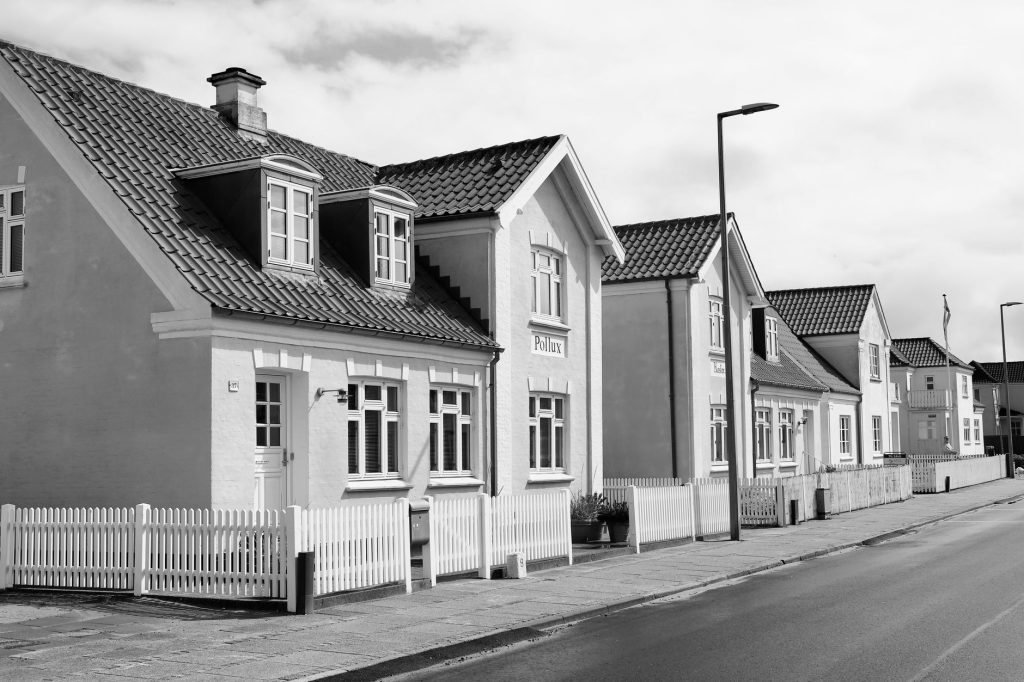
Here you get a clear picture of what a homeowners’ association (grundejerforening) is, which shared tasks it typically takes care of, and why many Danish houses and holiday home areas naturally come with one.
A homeowners’ association is a legally constituted association of property owners within a defined geographical area. It may be a residential area of detached houses, a holiday home area or an area divided into plots, and its purpose is to look after the shared interests that individual owners cannot take on alone.
The tasks are wide-ranging. Private shared roads, paths, green spaces, planting and lighting are typical, and some associations also look after playgrounds, coastal protection, internal sewers and perhaps a beach and a bathing or boat jetty. These are the kinds of things that would otherwise fall to each individual owner, but here they are handled jointly.
The association also acts as the owners’ representative in dealings with the municipality and other public authorities. This applies, for example, when local plans or the maintenance of private shared roads are up for discussion, and it means that as the owner of a house in the area you have a voice through the association rather than having to deal with the authorities on your own.
There is no general law in Denmark setting out how a homeowners’ association must be run. The association must comply with general association law, and you will find the specific rules in its articles of association and in any registered easements (servitutter). Terms vary from area to area, which is why those are the documents you need to know.
A homeowners’ association has real legal and financial significance, both when a house changes hands and while you live in it yourself. What the paperwork says determines how much you are liable for and what you have agreed to in practice.
Compulsory membership – check the registered easement and the local plan
Membership of a homeowners’ association can be voluntary or compulsory, and which one applies makes all the difference to what you are actually bound by. The obligation to be a member of the homeowners’ association is typically set out in the local plan (lokalplan) for the area or in a registered easement, that is, a declaration attached to the plot itself. So it is important to understand the link between the homeowners’ association and the registered easement before you sign.
The legal basis is section 15(2) of the Danish Planning Act (Planloven). It states that a local plan for newly established residential areas with gardens, business areas or holiday home developments can include provisions on setting up a homeowners’ association with compulsory membership. When the municipality itself divides an area into plots for detached houses, it often drafts and approves general articles of association that all buyers in the area must follow. In other words, membership is not something you can negotiate once it is in the paperwork.
| With registered compulsory membership | Without registered compulsory membership (voluntary membership) | |
|---|---|---|
| Can you leave the association after buying? | No. You cannot legally leave a homeowners’ association with registered compulsory membership. | Yes. You can leave with reasonable notice, unless agreements, the articles of association, the local plan or the subdivision declaration prevent it. |
| Does the membership go with the property when it is sold? | Yes. The obligation goes with the property and applies to the new owner from the handover date, while the previous owner’s membership ends when the new title has been duly registered. | No. There is no registered obligation to be a member. |
| Does the association have authority over you and your property? | Yes | No. If there is no registered obligation to be a member and you stay out, the association has no authority over you or your property. |
The obligation goes with the property, not the person. If you buy a house in an area with registered compulsory membership, you take over the previous owner’s rights and obligations towards the homeowners’ association. If, on the other hand, neither the local plan nor a registered declaration says anything about compulsory membership, you can legally choose to stay out.

The articles of association: what do they commit you to?
The articles of association are the legal foundation of a homeowners’ association. They set out the purpose of the association, who can or must be a member, and what rights and obligations you have as an owner in the area. The articles also lay down your voting rights, how the membership fee is set, which financial year the association follows and what the budget procedure looks like. On top of that come the rules on signing authority, that is, who can bind the association, and how liability is divided. This is the document that determines what you have actually agreed to and what you can demand in return.
The articles of association reach beyond the association’s internal affairs. They can also contain specific rules for your own plot and home. They might say how the hedge must be trimmed, or that all houses must have black roof tiles. As a member you must comply with such provisions, whether or not compulsory membership is registered, and whether or not you think the tiles would look nicer in another colour. That is because, as a member, you are obliged to follow both the articles and the lawful decisions made at ordinary and extraordinary general meetings.
Decisions are made at general meetings, where all members have a vote and so a chance to have their say. The majority decides, and its decisions are written into the articles, which all members are then obliged to follow. Voting follows the rules in the articles, and changes to the articles typically require a qualified majority of 2/3 or 3/4 of the votes cast. Changes that interfere with an individual owner’s right to use their own plot as they see fit, on the other hand, often require unanimity, so in practice you are protected against the majority making decisions about your own plot without your consent.
Registration in the land register (tinglysning) makes the articles binding on future owners of the properties in the association’s area. This is particularly relevant when compulsory membership or encumbrances are attached to the property, because a new buyer then cannot claim not to have known about them. Registration is done digitally through Det Digitale Tinglysningssystem (the Danish digital land registration system), and the process typically requires help from a lawyer or another legal expert. There is also a fee for each property on which the articles are registered, and that cost should be included in the association’s budget. Even without registration, an association needs articles of association to operate, but it is registration that creates clarity and makes them binding on new owners.

Membership fees and the association’s finances
There is no fixed price for membership. The fee for a homeowners’ association varies with the size of the association and the tasks it has taken on. As a rule of thumb, the fee is usually between 500 and 4.500 kr. a year, and if the association is also responsible for road maintenance, it can cost you a further 0-5.000 kr. a year, depending on the area. So the amount can range from a couple of hundred kr. a month to something that makes a clear dent in your budget.
The membership fee is the association’s main source of income, and it should be calculated on the basis of the approved budget so that it covers all planned expenses and leaves room for adequate savings. If the fee is set too low, the result can be neglected maintenance or sudden extra charges for asphalt, lighting or the playground. For your finances, this means a low fee does not necessarily mean cheap membership.
Payment is typically collected annually, every six months or quarterly. If you pay late, the association can follow procedures for reminders and reminder fees, and in the most extreme cases unpaid fees can result in a charge on the property. However, this typically requires legal assistance and should be a last resort. An unpaid fee is not a trifle but a debt that can end up attached to the house itself.
A healthy homeowners’ association builds its finances on dedicated savings for larger future expenses, ideally based on a maintenance plan that looks 5-10 years ahead. It is these savings that mean a new road or a renovated playground does not suddenly have to be paid for by a single generation of homeowners. When you look at a house, you should ask whether the association has such a plan.
When you sell, there are two things you need to know, because both concern money you will not get back. The association does not refund the seller any proportionate share of the annual contribution, even if the change of ownership happens mid-year. Nor can a member who sells claim payment of any part of the association’s assets, including any road fund. So you cannot count on getting back any of what you have paid in when you come to sell.
Homeowners’ associations when buying and selling a house: documents and practical checks
In a sale, it is the seller who is responsible for informing you of everything relevant about the homeowners’ association. As the buyer, you are entitled to know about compulsory membership before the purchase agreement is signed, so you know what you are committing to before you sign.
Before buying, you should at the very least be given the articles of association, the latest minutes of general meetings, the budget and annual accounts, and documentation of compulsory membership via the local plan or registered easements. You can see the documentation of compulsory membership on tinglysning.dk if you want to check it yourself.
Work through this checklist before you sign:
-
Read through the articles of association, focusing on compulsory membership, voting rules, payment rules and the board’s powers. This shows you how much you have agreed to and how much say you have.
-
Assess the accounts to get a picture of whether the association’s finances seem stable and whether there are savings for the maintenance that lies ahead. Accounts without savings are a warning of costs that have yet to surface.
-
Look through the budget for announced fee increases or planned projects. A project that is making its way into the budget typically means your costs will rise shortly after you have taken possession of the house.
-
Read the minutes of general meetings to find upcoming works or disagreements within the association. Disagreements about finances or major construction projects are something you inherit as a new owner.
-
Check the registered matters, that is, the easements and local plan provisions that bind the property. Here you can see whether membership is compulsory, whether there are encumbrances concerning shared areas and road access, and whether there are restrictions on appearance and planting.
Also ask whether major works have been decided but not yet fully charged for. This is because whoever owns the property at any given time is liable for its obligations to the homeowners’ association, including any arrears, and the previous owner can remain stuck with the debt until the new owner has settled the arrears.
What does a homeowners’ association mean for property value and for your decision?
Seeing a homeowners’ association mentioned in a sales brochure is not a red flag in itself. It is a sign that there is something you should look into more closely. After all, you don’t read a condition report or a local plan to confirm that the house is in poor shape, but to know what you are buying. The articles of association, the finances and the minutes belong in exactly the same category. They tell you what has been agreed, what has been paid and what is on the way.
It is worth understanding how active the association is. It can have a big influence on the maintenance of shared areas, on decisions about how the area develops and on representing residents to the authorities. It can even help shape local plans and changes to them. When you buy a house in an area with an active association, you are not just acquiring your own plot. You also get a vote and become a co-owner of the decisions that will shape the area around you for many years to come.
The answer to what a homeowners’ association means turns out to be more nuanced than a simple definition. Its value depends not on whether the association exists but on how it works. Clear and up-to-date articles of association, a realistic membership fee, a long-term maintenance plan and open communication with members are what make the difference. An association that has these four things under control is an asset to the area and to the value of your property. One without them can become an expense you only discover after the handover.
The point is the same whether you are buying or selling: the paperwork decides what the deal really involves. Read it before you sign, and ask the questions that feel a little awkward. If you need to get on top of the homeowners’ association’s paperwork before a purchase or sale, you can contact Brikk for a review of the specific documents, so you know exactly what you are signing.
Leave a comment