
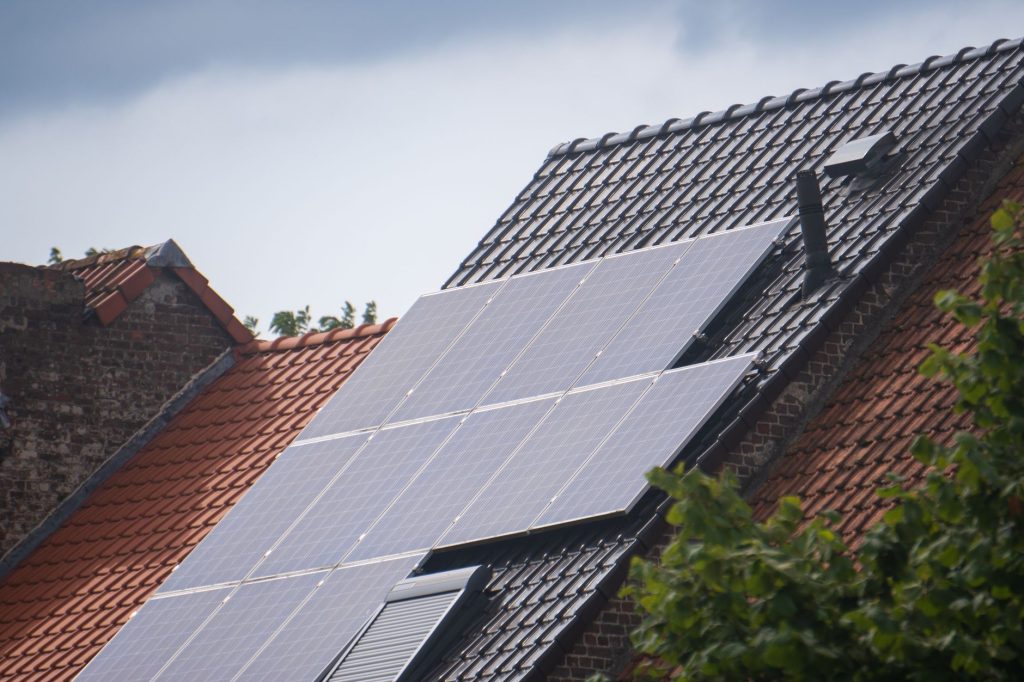
A green loan or energy loan is a loan you use to make your home more energy efficient. It is available both as a green mortgage loan (realkreditlån) and as a green bank loan, and the interest rate can be slightly lower than on an ordinary loan.
There is, however, one clear condition. The money must go towards an energy-improving purpose, for example extra insulation, a new roof with better insulation, energy-efficient windows, solar panels or a heat pump. What counts depends on the lender, so ask about the conditions before you apply.
If energy renovation is only one of several purposes in a larger renovation project, typically only the part that goes towards energy measures can be financed on green terms. You will have to borrow for the rest on ordinary terms.
Green mortgage loans are earmarked for projects with a positive environmental impact. In this article, you get an overview of energy loans, ordinary renovation and extensions, so you can see which form of financing suits your project.
Loans for energy renovation: mortgage credit, bank loans and home credit lines
For energy renovation, you typically have three options, which differ in interest rate, term and how quickly the money is in place. The table below brings the three options together, so you can compare them on the same points.
| Loan type | Indicative interest rate | Term | Security/collateral | Best for |
|---|---|---|---|---|
| Green mortgage loan | Typically slightly below an ordinary mortgage loan, see the rates further down | Up to 30 years | Secured on the home | Larger projects with a clear energy gain |
| Green bank loan/energy loan | Approx. 3-6% | Up to 10 years | Often no new registration, quick processing | Small and medium-sized projects |
| Home credit line (overdraft secured on the home) | Approx. 4-7% | Open-ended, no fixed repayments | Secured on the home | Projects that change along the way |
The mortgage loan usually has the lowest interest rate. The price of that low rate, however, is time and cost: processing takes longer, and on top of that there is a land registration fee (tinglysningsafgift) of 1.825 kr. plus 1,25% of the amount secured by the mortgage. If you borrow to replace an oil or gas boiler in your year-round home with a different heat source, you can have the fee refunded, provided at least 90% of the loan goes on the replacement and the boiler is replaced within 12 months. The scheme applies to mortgages submitted for registration up to and including 31 December 2028. So mortgage credit often wins on the interest rate, but only if you can wait for the paperwork to be in order.

Mortgage loans for energy improvements: requirements, documentation and grants
A green mortgage loan is only for projects with a positive environmental impact. The loan has to go towards something that genuinely makes a difference to energy consumption, and the typical uses are extra insulation, a new roof, energy-efficient windows, solar panels or a heat pump. If your project is something else entirely, you are looking at the wrong loan.
That is also why documentation is a standard part of the process. You must be able to show that the measure genuinely saves energy, and this is typically done in one of these three ways:
-
An energy label for the home showing the starting point and the improvement
-
A report from an energy consultant assessing the measure
-
Product documentation from the contractor confirming the effect of what is being built
Without that documentation, the bank will find it hard to judge whether the project meets the requirements for a green loan, so make sure you have the paperwork ready before you apply.
The application itself is about more than energy. When you apply for a loan for energy improvements, you provide details of the purpose, your finances, your home and your employment for the bank’s credit assessment. The details have to add up before the loan comes through.
It can also pay to look into public grants before you borrow. Energistyrelsen (the Danish Energy Agency) opened its Energirenoveringspulje (energy renovation grant pool) for applications on 27 January 2026 and allocates the money on a first-come, first-served basis, so check sparenergi.dk to see whether there is still money left in the pool. The house must be your own year-round home with an energy label in category D, E, F or G, and you must not start the work until your grant has been approved. The grant is only paid out once the project is finished, so you still need to be able to finance the whole project in the meantime.

Mortgage loans for energy renovation: current interest rates and costs
| Loan type | Interest rate, October 2026 |
|---|---|
| Fixed-rate loans | Around 5% |
| F-kort loans | Around 2,2-2,3% |
A green loan typically comes in slightly below a traditional mortgage loan. The explanation lies in the bond market: investors pay a slightly higher price for green bonds, and that discount ends up with you as the borrower. It is not a dramatic cut in the interest rate, but over a number of years the difference adds up.
You pay for the low rate elsewhere, though. The set-up costs are high because the home has to be valued and the mortgage registered. The land registration fee alone is 1.825 kr. plus 1,25% of the loan amount, so on a loan of 1.000.000 kr. it comes to 14.325 kr., and on top of that come fees and brokerage. You should also allow for a process of 4-8 weeks before the money is in place.
You can choose a fixed rate for up to 30 years, and the lender cannot call in the loan as long as you keep up your payments. Your monthly payment will not suddenly shift in the middle of a renovation.
Mortgage loans for renovation: loan-to-value and alternatives
A green interest rate advantage is not a given. A green loan is only cheaper if the bank or mortgage lender actually gives you a lower rate for your particular project, and that assessment varies from lender to lender. The same project can get a lower rate in one place and a perfectly ordinary rate in another, so it pays to get quotes from several lenders before you decide.
When you use a mortgage loan for renovation, the lending limit determines how much you can borrow. As a rule, the mortgage loan covers up to 80% of the home’s value, while the limit for a holiday home is 75%. The limit applies to all mortgage debt on the home, so how much you can borrow for the renovation depends on how much you have already borrowed.
The part that mortgage credit cannot cover has to be financed some other way, for example with a bank loan, a home credit line (boligkredit) or your own savings. How much the bank will lend you depends on its credit assessment of your finances.
If the project is small, on the other hand, an entirely different calculation can make sense. If the work costs less than 100.000 kr., it is often cheaper to take out a consumer loan than to refinance your existing mortgage loan. The exception is if you were going to refinance the loan anyway for other reasons, because the costs then coincide with something you had already planned.
Loans for an extension: budget and valuation
For most homeowners, a mortgage loan is the cheapest way to finance an extension. The interest rate is lower than on both bank loans and consumer loans, and you can stretch the term to up to 30 years, which keeps the monthly payment manageable.
There is one condition you need to know about before you start, though. Together with your existing loans, a mortgage loan for an extension must stay within 80% of the home’s value, as measured by the lender’s valuation. If you do not have enough equity in your home today, the loan depends on the finished home being valued higher than it is now. The valuation is therefore not a formality but the very condition for the loan going through.
The roof is often the item that surprises people most when the budget is drawn up. For a 30 m² extension, two common options look like this:
| Roof type | Cost of materials | Laying time |
|---|---|---|
| New tiled roof | 30.000-40.000 kr. for materials alone, plus labour | Takes longer to lay |
| Felt roof | Typically half the cost of a tiled roof | Quicker to lay |
So a tiled roof costs more and takes longer to build, while roofing felt keeps the cost down and goes on faster. Which way you go depends on how much you want to invest in the roof and how long you can live with scaffolding around the house.
Two things you should take into account before you sign anything at all:
-
Add 10-15% on top of the estimated budget as a buffer, because something almost always crops up along the way.
-
Get quotes from at least three contractors, and contact the bank with the total budget, asking about mortgage loans, home credit lines and any grant schemes.
Once you have those figures on the table, it is easier to see how much you really need to borrow and whether the valuation of the finished home can support the project.
Mortgage loans for an extension: advance loans and valuation during construction
During an extension, the money does not always keep pace with the building work, and that is where the advance loan (forhåndslån) comes in. An advance loan is a mortgage loan you take out before construction begins, and it is based on the expected value of the home once the work is finished. The full loan is paid out in one go and deposited in a blocked construction account at the bank. From there, the money is released to the project in instalments as the work progresses.
The order is fixed. First you apply for the loan on the basis of the project you have planned. Then the bank or mortgage lender sends out a valuer, who estimates what the home will be worth once the extension is finished. That valuation is the figure the loan is based on, which is also why you need to have drawings and a budget ready before the process gets properly under way.
Along the way, the costs come in waves. The contractors need paying as they work, while materials and subcontracted work fall due at different times. This is where a home credit line can be a practical supplement. It works like an overdraft secured on your home, and you only pay interest on the amount you actually draw. If you draw nothing for a while, it costs you no interest for that period either.
That makes the home credit line flexible in exactly the phase when you cannot predict precisely when the bills will land. You can draw on it when payments are due and pay it back down when your finances have some breathing room. It works on a different logic from a fixed loan with a fixed monthly payment.
A new 1st floor, built by raising the roof, is a more mixed case. Here the bank or mortgage lender assesses how much of the budget actually goes on energy measures. Only that share can be financed on green terms, while the rest has to be covered on ordinary terms. So if you are picturing a green loan for the whole project, that will not hold up when the new floor also brings new rooms and a changed layout.
Financing a renovation: debt factor, stress test and contribution rates
The bank looks at your finances as a whole when you apply for renovation finance. There are four factors worth knowing about before you sit down with the application.
-
If your household has a debt factor (gældsfaktor) above 4, meaning total debt of more than four times its income before tax, and the loan-to-value ratio is above 60%, you cannot as a rule get a variable-rate loan where the rate is fixed for less than 5 years. In that situation, an interest-only period requires a fixed rate for the full term.
The debt factor is the figure that can stop an application fastest, because it looks at your total debt and not just the new loan. If you are building an extension and keeping an existing loan, the two amounts go into the same calculation.
The stress test applies to you if you choose a variable-rate loan and the home is in a growth area, which currently means Copenhagen and the surrounding municipalities, plus Aarhus. The bank tests whether your finances can cope if the interest rate rises 1 percentage point above the current 30-year fixed rate, and to at least 4%. A fixed-rate loan is exempt from the test.
The contribution rate (bidragssats) is the ongoing payment to the mortgage lender, and it depends on how much of the home’s value you borrow. If you borrow up to 40% of the value, the rate is at its lowest, and it rises as you move up into the 40-60% and 60-80% bands. This means the last part of the loan is the most expensive to carry.
Construction loans and overdraft facilities work differently from a fixed loan, precisely because you only draw the amount you need at the time. The flexibility comes at a price in the form of a variable interest rate that is often higher than on a mortgage loan. On the other hand, you do not pay interest on money you have not yet spent.
Loan-to-value for renovation: limits and requirements
How much you can borrow for renovation depends on the type of home you own and how much you borrow relative to its value. The table below shows the limits you need to stay within.
| Property type | Max. mortgage loan | Max. total borrowing |
|---|---|---|
| Ordinary home | 80% of the home’s value | Up to 100% for renovation |
| Holiday home | 75% of the home’s value | Up to 100% |
The difference between the two columns matters. Mortgage credit covers up to 80% of the value of an ordinary home, but you can borrow the rest from the bank, so total borrowing for renovation can reach up to 100%. On a holiday home the mortgage limit is lower, at 75%, while total borrowing can still reach up to 100%. That does not necessarily mean you can borrow right up to the ceiling. The bank still assesses your finances, and the last few per cent are the most expensive to carry.
There is a special rule that can matter if your property mixes categories. A mortgage lender can lend against the whole property under the rules for a single property category if that category makes up at least 80% of the property’s total gross floor area. So if the residential part is large enough relative to the total area, the lender can treat the property as a whole instead of dividing it up.
The requirements for you as an applicant apply whatever the type of home. You must be at least 18 years old and have a permanent address in Denmark. If you are registered in RKI (Denmark’s register of bad payers), most banks will automatically reject your application, so get that sorted before you start gathering paperwork.
Mortgage loans can finance both renovations and extensions within the lending limits that apply to your home, but it is your loan-to-value ratio and personal circumstances that set the real limit on how much you can borrow. A practical first step is to check your loan-to-value ratio and gather the documentation the bank asks for before you send off your application.
Leave a comment