
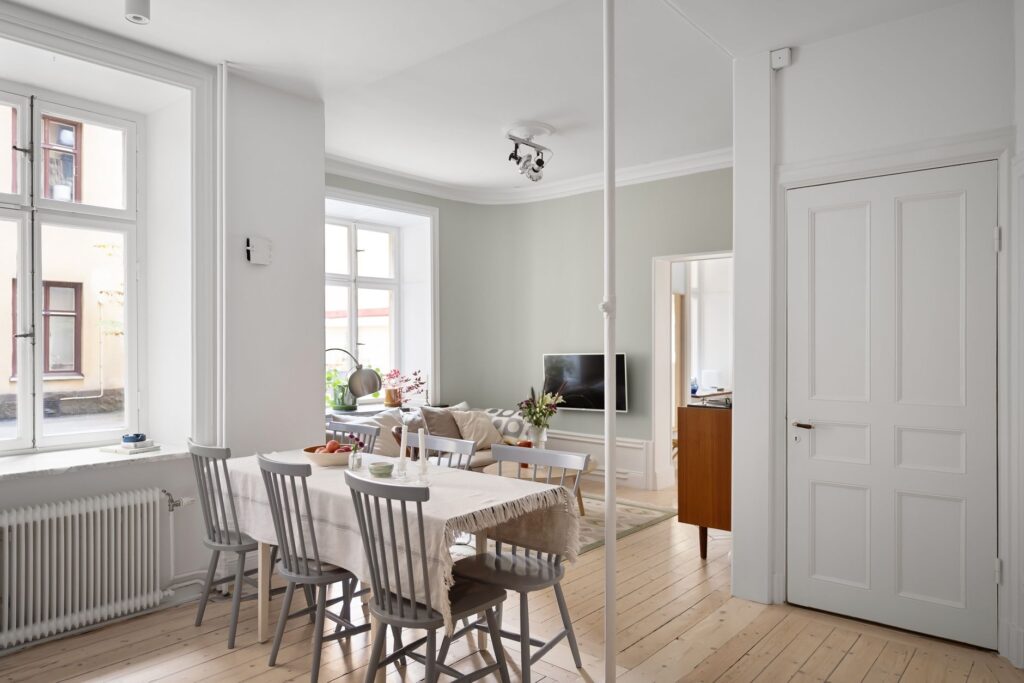
A flat valuation is not an educated guess. When the estate agent steps into your home, they work to a fixed framework: condition, potential and price level all have to be mapped out during the inspection, and the focus is on the factors that actually move the price, not on whether the place has been tidied. You do not need to scrub the floors or hide the clutter to get an accurate valuation. What counts are the physical features the agent can see, measure and compare.
Type of flooring, ceiling height, natural light and the quality of the building materials all go into the notes, because these are the things that set two otherwise identical flats apart. At the same time, the agent looks for factors that add value and factors that reduce it, which no database knows about: natural light, layout, quality of materials, state of repair, noise and neighbours. Photos are often taken during the inspection to document the home’s current condition. Set aside 30-60 minutes at home, and be aware that the agent typically spends 1-2 hours in total on preparation, the visit and follow-up work.
What affects the price of a flat
The price of a flat depends on many factors, but they do not carry equal weight. Some you can do something about, others are fixed, and the order below shows how much each one typically moves the price.
-
Location and neighbourhood
-
Floor area and plot size
-
Property type
-
Roof, windows and installations
-
Practicality of the layout
-
The market and interest rates
-
Energy label
-
Kitchen and bathroom
-
Maintenance and tidiness
-
Furnishing and colour choices
Location is the single biggest factor, and the only one that is entirely out of your control. Houses in Copenhagen sell for around 54.781 kr. per m², while the national average is 18.626 kr. per m². You can renovate, furnish and maintain as much as you like, but you cannot move the address.
Neighbourhoods in the same municipality can be 30 % apart in price, so a municipal average is a guide, not a valuation. Two flats of the same size and condition can therefore sell for very different prices if one of them is on the right side of a busy road.
For an owner-occupied flat, it is the floor level, a lift, a balcony, the view and the owners’ association’s debt that carry the most weight. The age of the building, on the other hand, matters less than many people think. An old building in a good location with an association in sound financial health can easily be in a stronger position than a newer block of flats without the same qualities.

Floor area, documentation and the owners’ association’s finances
When you compare your flat with others in the neighbourhood, the floor area is the first thing you should keep track of. In BBR, the Danish building register, an owner-occupied flat’s living area is a gross area, which can include a share of the stairwell and other shared access areas. The area registered with the land registry (tinglyst areal) is calculated on a different principle and does not include this share, and the internal floor area is a third measure altogether. Three figures, three methods, and they rarely give the same result.
The registered area of an owner-occupied flat can also include separately registered basement or loft rooms. That is why a price per square metre is only useful if the areas have been measured on the same principle. If you compare your BBR figure with your neighbour’s registered area, you may get a figure that looks off, without anything being wrong with either of them. A price based on a mix of area measurements will not hold up once the buyer starts doing the sums.
Before you use the information as an argument for your price, go through the papers of the owners’ association (ejerforening). This is where a flat valuation often falls into place or falls apart, because the association’s finances can weigh more heavily than the home itself.
-
The owners’ association’s bylaws
-
Minutes of general meetings and board meetings
-
Accounts and budget
-
Maintenance plan
-
Insurance details
-
Owners’ association information form (ejerlejlighedsskema)
-
Any joint association loans
An estate agent’s valuation of an owner-occupied flat rests on more than walls and floors. Keep these four things apart: an identified maintenance need, a proposal, an adopted decision and a financing plan. They mean different things for the price. Information about the association is often the first thing a buyer’s adviser asks for, so have it ready before anyone asks.

Energy label, condition report and electrical installation report: What does a flat valuation cost
When you sell, three reports work together, but they have very different status and very different prices. Only one of them is required by law, and it is worth knowing the difference before you set anything in motion.
| Document | Required by law? | What it is used for / who carries it out | Price range |
|---|---|---|---|
| Energy label | Yes, the only one of the three documents that is, as a rule, required by law when selling most year-round homes | Must be in place when the home is advertised | 4.500-8.000 kr. |
| Condition report | No, not required by law | Needed to use the home inspection scheme and offer change-of-ownership insurance; without it, the seller carries a 10-year liability for hidden faults and defects | 6.000-12.000 kr. |
| Electrical installation report | No, not required by law in itself | Part of the home inspection scheme and carried out by an authorised electrical contractor | 2.500-4.500 kr. |
| Combined package through an estate agent | Not applicable | The three reports as one package through the agent | 13.000-22.000 kr. |
The energy label (energimærke) is the one you cannot skip. It must be available when the listing goes live, and it is valid for 10 years, so in many cases an older label can be reused if no major changes have been made to the home. For an owner-occupied flat, it is the owners’ association’s job to obtain the label for the whole building, and you are entitled to a copy at any time, free of charge. The association must have an agreement with an energy labelling company in place no later than three weeks after your request, and deliver the label within 60 days.
The condition report (tilstandsrapport) and the electrical report are optional, but they are your ticket into the home inspection scheme (huseftersynsordningen). If you opt out of them, you as the seller remain liable for hidden faults and defects for 10 years. If, on the other hand, you offer change-of-ownership insurance (ejerskifteforsikring) and pay at least half of the premium, you can in many cases free yourself of that liability in the areas the insurance covers.
All in all, valuing a flat rarely costs anything as such. The estate agent’s valuation is typically free, and it is the three reports that make up the real cost. If you already have a valid energy label through the association, the bill drops accordingly, leaving only the condition report and the electrical report to decide on.
How to get a realistic valuation before you sell
A realistic valuation of your home does not land in your lap as a single figure on a website. It is built up step by step, and you can do most of the work yourself, long before an estate agent sits down at the table. The order below is the same one a professional uses.
-
Set the valuation date, and find completed sales from the nearest relevant market for owner-occupied flats. Compare timing, building type, size and key practical features. The fewer relevant sales you find, the more uncertain the range becomes.
-
Use the same definition of floor area as the sales you compare with, and adjust for layout, floor level, lift, outdoor space, light, noise and documented condition. Even two flats in the same building can be hard to compare directly if these factors differ.
-
Go through the owners’ association’s finances and decisions, meaning the articles of association, accounts, budget, maintenance plan and any joint loans. This is where you see whether there are shared costs ahead that a buyer will factor into their offer.
-
Record uncertain factors as a range in the valuation rather than one precise figure. An honestly stated range gives you a better basis for decisions than a round number you cannot document.
-
Update the range when new information about floor area, communal works or financing is documented. Between the valuation and the final sale there are also variables such as the number of buyers, how aggressively they bid, and whether it ends in a round of bidding or a price reduction.
If you want a pre-sale valuation of your flat that holds up all the way to the signing, you can book a flat valuation and have an estate agent go through the same steps for your particular home.
Get a free flat valuation and use it wisely
An estate agent’s valuation typically lands within ±5-7 % of the final sale price. That makes it the most precise tool you have when you need to put a figure on your home. But the uncertainty grows if the flat has special qualities such as a view or unusual architecture. Those are precisely the homes that deviate most from any valuation, because there are not many comparable sales to lean on.
The estate agent usually does not charge for the visit, because the valuation is how they win the instruction to sell your home. That means there is a built-in incentive to give you a figure that is a little optimistic. You should therefore get more than one valuation and compare them before you decide anything.
Also remember what a valuation actually is. It is not a guarantee of a particular sale price, but an informed estimate under normal market conditions, with a professional sales effort behind it. The actual sale price is something else: it is exactly what one specific buyer is willing to pay at one specific point in time.
If you want a concrete valuation of your flat, you can book a flat valuation and get a review of the factors that really move the price of your particular home.
Leave a comment