
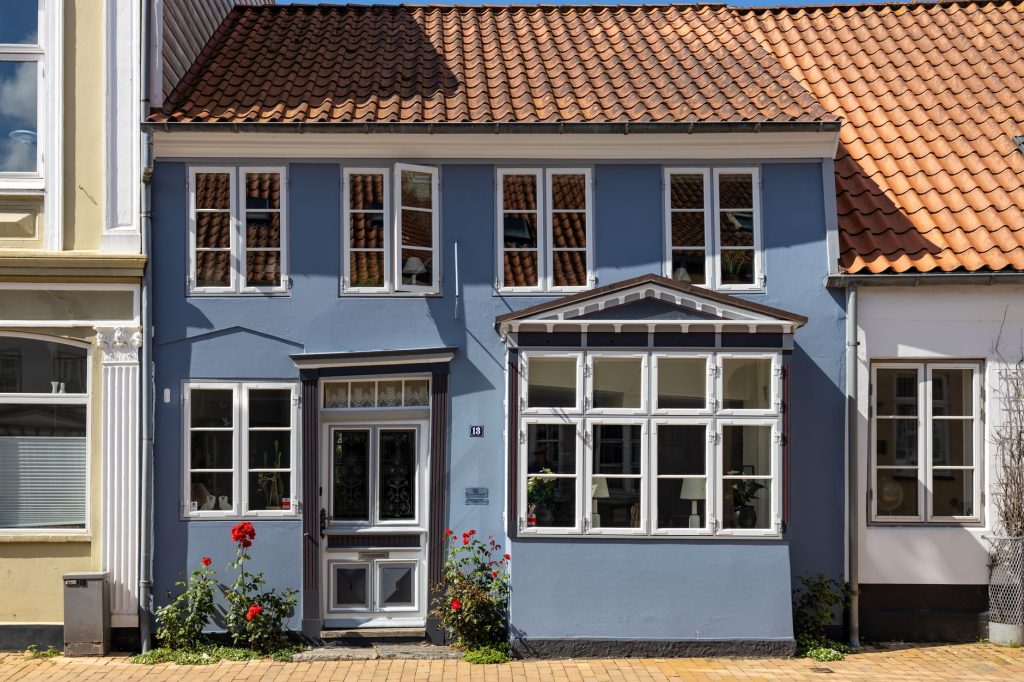
If a listing says an allotment garden (kolonihave) has year-round status, that does not automatically mean you may use it as a permanent home. The Danish Allotment Gardens Act (kolonihaveloven) generally prohibits year-round living, and only a few associations and municipalities have special rules that allow it.
When a listing says “year-round status”, it usually refers to the specific allotment association’s by-laws or the municipality’s local plan (lokalplan). There is no national standard, so you cannot count on the rules of one association applying in another.
Nor does the Allotment Gardens Act itself set out how long you may stay in the garden. The period can be governed by local plans, lease agreements and association rules, so it varies from area to area.
This article takes a concrete look at what you are actually buying, how valuation and prices are linked, what financing options are available and how to be in with a chance through waiting lists. The aim is for you to move forward with your own association in mind, rather than carrying rules over from one association to another.
Buying an allotment garden: association garden or privately owned garden
In an allotment association, the association typically leases the land from the municipality. So you buy the house on the plot and at the same time take over a lease or a share in the association. The land does not come with it in the same way as in an ordinary house purchase.
| Association garden | Privately owned garden | |
|---|---|---|
| What you own | The house and a lease or share in the association | House and plot |
| How the sale typically works | Within the association | Through an estate agent, on portals such as Boligsiden |
| How the price is set | An assessed maximum price in Kolonihaveforbundet’s associations | Freely agreed between buyer and seller |
The privately owned garden is the other model. Here you own both the house and the plot, just as with a detached house, and the sale often goes through an estate agent and is advertised on portals such as Boligsiden. That makes a privately owned garden the easiest to compare with an ordinary home purchase.
In associations under Kolonihaveforbundet (the Danish allotment garden federation), the houses may only be sold at an assessed maximum price. The price is not set freely, and you cannot bid above it to jump the queue. Communal work is a duty under the by-laws, so membership comes with obligations, however much you use the garden yourself.
A large share of the cheapest gardens never reach the estate agents. They are traded internally through waiting lists and physical noticeboards, so the best and cheapest opportunities can be gone before they appear in a listing.

Rules on year-round living in an allotment garden
The law is clear on one point. Under section 2(1)(4) of the Allotment Gardens Act, buildings in an allotment garden area may not be used for year-round living. That is the starting point, whatever a listing or a seller tells you.
From there, the picture becomes more local. It is the local plan and the association’s by-laws that determine what the rules on year-round living look like for the garden you are thinking of buying.
The period of stay often follows a fixed pattern. The summer half of the year typically runs from 1 April to 30 September, when overnight stays are allowed. In the winter period from 1 October to 31 March, you may only stay overnight for holidays and weekend breaks, not as your permanent residence.
Some municipalities set their own, more precise dates. Odense allows you to stay overnight every night from 1 April to 31 October, but from 1 November to 31 March you may only stay overnight at weekends and during the school holidays. This shows that the rules can vary from one municipality to another.
The residency requirement is something many people overlook. In many municipalities, especially around Copenhagen and Aarhus, you must have your registered address in the same municipality as the allotment garden to be allowed to buy it. The workaround of registering your address with family or friends while you actually live in the garden all year round is illegal and can cost you the right to the garden.
Before you sign, you should read through your own association’s by-laws and look up your municipality’s local plan. Periods of stay, residency requirements and the scope for legal year-round living vary from place to place. It is these two documents, not a listing, that decide what you are allowed to do.
Building rules and pitfalls in the allotment garden
There is no single set of building rules that applies to all allotment gardens. They vary from municipality to municipality and from association to association, so you need to know both the local plan and your own association’s rules. One example is the guidelines from Københavns Kommune (Copenhagen Municipality) for gardens where you may stay overnight:
-
The maximum site coverage is 20% of the plot.
-
The house itself may be no larger than 60 m² on plots of 300-400 m².
-
The house may be no more than 4 metres high, and the facade height no more than 3 metres.
-
The minimum distance to the boundary is 2,5 metres.
Whether you need to apply for a building permit depends on the local plan. If the size and position of the house are laid down in a local plan, a town planning by-law or a registered declaration, you can build without a building permit, but the work must still meet the requirements of the Danish Building Regulations that apply to allotment garden houses. Otherwise, you need to ask the municipality whether a building permit is required. Get this sorted before you plan an extension or a new shed.
As the buyer, you inherit the responsibility, and the bill, for illegal building work. If the covered terrace or the shed was built illegally, you are the one left with the problem afterwards, and in the worst case with a bill for demolition. So check the building thoroughly before you sign.
Before you buy, you should check:
-
Whether the covered terrace or the shed is registered in BBR (the Danish building register) or on the association’s drawings.
-
Insurance for the house and contents, and whether the association has a joint insurance scheme.
-
What the association’s by-laws say about sewerage and waste water.
You cannot settle any of these points from a listing alone. Get out the by-laws and the local plan, and find out what the building rules are for your particular garden before any money changes hands.
How an allotment garden is valued
When you buy an allotment garden in an association under Kolonihaveforbundet, the price is not something you and the seller negotiate. The associations follow Kolonihaveforbundet’s fixed valuation rules, and the valuation sets a maximum price, which is the most the seller may ask. It is not a starting point for a bidding round, and you cannot bid above it to secure the garden. It is similar to the maximum price for cooperative housing (andelsbolig).
The valuation is carried out by the association’s valuation committee, whose members have attended several valuation courses and calculate the value according to Kolonihaveforbundet’s current rules. The report consists of three main parts, each depreciated at its own rate:
-
The main house, i.e. the building itself, with its timber, masonry and foundations.
-
Other structures such as sheds, covered terraces and greenhouses.
-
Fixtures and improvements, for example the kitchen, bathroom, electrical installations and drains.
Because the three parts age and depreciate differently, two gardens that look alike from the outside can end up with very different valuations. The category also plays a part. A house in particularly good condition, built to a proper professional standard, insulated according to the regulations and made with high-quality materials, achieves the highest price per square metre. The typical self-built house is in average condition: it works fine but shows signs of ordinary wear and tear or DIY solutions.
Movable items have their own rule, and this is where you can save money. Movables such as a sofa, curtains, garden tools and a fridge may make up no more than 20% of the total valuation. They must be priced at their real value in use, i.e. the second-hand price rather than the price new. As the buyer, you have no obligation to take over movables, so you can say no thanks to furniture and garden equipment you do not need.
A valuation report is typically only valid for one year. If the report is older, you should insist on an updated valuation approved by the board before you sign. If the valuation committee has overlooked improvements or set the wrong category, the valuation can be appealed to the district (kreds). There is usually a fee for this, and be aware that the new valuation may end up lower than the original one.
Under-the-table payments are against the by-laws and can cost you your membership.
Building lifespans and condition categories in the valuation
An allotment garden house rarely rises in value over time. It falls, and the value is based on what it costs to build the house today, minus a deduction for its age. So it is not what the seller paid for the garden that sets the price, but what the building is worth now.
| Building type | Lifespan | Annual loss in value |
|---|---|---|
| Wooden house in good condition | 40-50 years | 2,0%-2,5% |
| Brick or aerated concrete house | 60-70 years | 1,4%-1,7% |
| Single-glazed conservatory | 20-25 years | 4,0%-5,0% |
| Tool shed | 15-20 years | 5,0%-6,7% |
The table shows that the type of building has a big impact on the valuation. A brick house lasts a long time and loses value only slowly, while a tool shed and a single-glazed conservatory age quickly and fall significantly in value every year. The materials and craftsmanship behind them matter more to the price than many people expect.
Condition category 3, “Poor condition / Demolition”, covers houses that are leaky, rotten or illegally built. They are often valued at 0 kr. or with a direct deduction for the cost of demolition. So here you are not paying for the house, but you risk taking over the bill for having it removed.
When you read a valuation report, remember that a house in this category can look cheap on paper. The price reflects that the building has no real value and that you will have to deal with clearing it away yourself.
Allotment garden prices in 2026
The price of an allotment garden depends largely on the type of garden you are looking at. If the garden is part of an association under Kolonihaveforbundet, the price is typically between 50.000 and 250.000 kr. in 2026. If, on the other hand, you are after a cooperative garden (andelshave) or a privately owned garden on the open market, where the price is set freely, you can often expect to pay 150.000-700.000 kr. The difference is mainly because gardens in Kolonihaveforbundet’s associations may be sold for no more than the assessed maximum price, and because with a privately owned garden you also buy the plot. Location, size and standard also play a part.
Where in the country you are looking matters at least as much as the type of garden. Here are two examples:
| Valuation price | Garden rent per year | Waiting time | |
|---|---|---|---|
| Copenhagen and the surrounding area | 100.000-400.000+ kr. | 10.000-17.000 kr. | 5-10+ years |
| Kalundborg and Sorø | 10.000-80.000 kr. | 2.000-4.000 kr. | Short |
Of the two examples, Copenhagen and the surrounding area is clearly the more expensive, in both valuation price and annual garden rent, and you should expect to spend many years on a waiting list. In Kalundborg and Sorø, costs are markedly lower, with a valuation price of 10.000-80.000 kr. and garden rent of 2.000-4.000 kr. a year.
The purchase price is only part of the calculation. Running costs come on top every year:
-
The association membership fee is typically 500-3.000 kr. a year.
-
You also need to factor in insurance for the house and contents.
-
The total annual running costs come to 15.000-30.000 kr. in Copenhagen, but only 5.500-15.000 kr. in the provinces.
Add up those figures before you make an offer on a garden. A low valuation price in the provinces can mean a markedly lower total cost over the years than an expensive garden in the Greater Copenhagen area, where both the rent and the running costs push up the annual outlay.
Allotment loans: why you often cannot get a mortgage loan
You typically cannot get a mortgage loan (realkreditlån) for an allotment garden. The house stands on leased land and cannot be borrowed against like a detached house, however attractive and well kept it is. The bank does not view an allotment garden the way it views an ordinary family house, because there is no land to secure the loan against.
That does not mean financing is impossible. Most banks offer special allotment loans (kolonihavelån), where the interest rate is typically higher than on a home loan but lower than on a consumer loan. You should be prepared for a different interest rate and different terms than if you were buying an ordinary home.
The cheapest route is to pay from your own savings. Many associations require proof that the money is in place before you sign the purchase agreement, so it is not enough to have a plan to raise it later. If you have the money set aside, you are ready when your turn comes, and you avoid paying interest.
The alternative is to buy a freehold garden (ejerhave), where you own the land and therefore have something to borrow against. On the other hand, the price is markedly higher than in a sale through an association, so the sums look quite different when the land comes with it.
Allotment garden waiting lists: how to be in with a chance
If you want one of the inexpensive gardens in an association, the waiting list for allotment gardens is often the way in. There are several specific places to sign up, and they do not all work the same way.
-
The waiting lists are on the associations’ own websites: some have open lists you can join for an annual fee, while others only open for sign-ups on certain dates. Popular lists fill up in minutes, so be ready the moment sign-up opens.
-
Go and visit the association in person. Many have a noticeboard by the clubhouse where gardens for sale are posted, and where you can see when you can put your name down.
-
Use the local Facebook groups for each neighbourhood. They are often quicker than the national sales sites, because the posts appear where the neighbours are already keeping an eye out.
In an association sale, you pay no more than the assessed maximum price, but you often have to wait a long time for a garden. The open market has no waiting lists, and you can buy straight away if you have the money, but prices are markedly higher.
Brikk’s buyer register and free sales valuation
If you are looking for an allotment garden, you can sign up to Brikk’s buyer register, where allotment garden is one of the property types you can select. It is free, and you will be notified when a home that matches your wishes comes up for sale.
If you own an allotment garden on your own land and are thinking of selling, you can get a free, no-obligation sales valuation from Brikk. If the garden is in an association under Kolonihaveforbundet, it is the association’s valuation that sets the price. If you are on the buying side, you can look through the current homes for sale and weigh up what is available before you put your name on a waiting list or go out to view a garden.
Leave a comment